S_4_S (Song for Silence)
für accidental sounds, Live-Elektronik und 4.1-Kanal Sound
Uraufführung | 22. Mai 2025 | Festivals Aux Chandelles | Villa Burrus, Sainte Croix aux Minnes
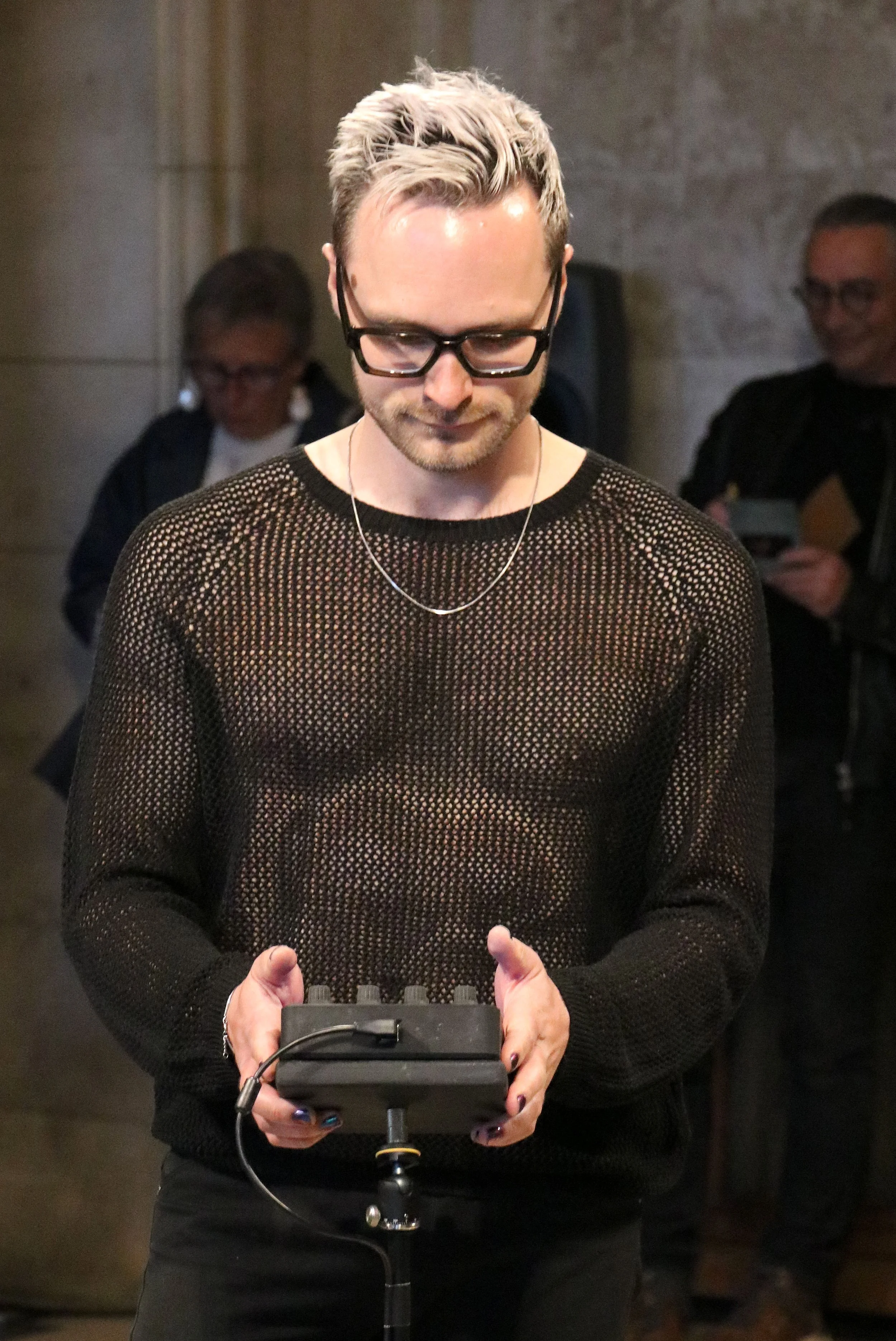
Have you ever listened to silence?
What is it that you hear?
What is happening around you when nothing is happening?
What do you hear when there is nothing to hear?
– Supposedly –
I am going to let you in on a secret:
Silence – “the absence of sound,” as it is commonly understood — does not exist naturally on earth.
Let that sink in.
Actually… it isn’t much of a secret. It’s a physical phenomenon.
The 20th-century American composer John Cage famously stated:
"Try as we may to make silence, we cannot [...] Until I die there will be sounds. And they will continue following my death. One need not fear about the future of music."
Silence – in my understanding – is “the absence of definite action.”
It is what happens when you and those around you do not actively produce sound or, even more, try to actively not produce sound.
(Or visual cues, for that matter – but we won’t go into that…)
For now, let us go back to listening to silence.
What does one hear when listening to silence?
– You will have to find out for yourself –
But before we embark on this journey, we must answer one question:
What does it even mean to listen? And how does listening relate to hearing?
"To hear is the physical means that enables perception. To listen is to give attention to what is perceived both acoustically and psychologically."
I didn’t write that… It is a quote from another musical pioneer of the 20th and early 21st centuries. Her name was Pauline Oliveros, and she developed a whole, quite elaborate, practice around that notion.
She called it Deep Listening. She also wrote a book about it, which, also, is called Deep Listening.
And that is what I am inviting you to do. I am inviting you to listen – deeply. To give attention to what is happening around you and, at the same time, observe what happens within you.
You might observe with your eyes open or, at times, close them to focus your attention on sound.
After the piece is over, I ask you to take some time for yourself. Keep your phone in its paper bag and switched off. Take a walk outside or find a quiet – silent – spot to sit down. Try to remember what you perceived, – what you heard and felt.
The starting point of S_4_S is the observation that absolute silence does not exist. Silence is understood here as an “absence of definite action”: a state that emerges when sound is not actively produced while attention nevertheless remains present.
Philosophically and epistemologically, the work draws on ideas associated with John Cage and Pauline Oliveros, while translating these perspectives into an independent compositional practice.
S_4_S is fully composed and follows a clearly defined dramaturgical trajectory. The compositional framework establishes temporal processes, modes of listening, and transitions between density and reduction. At the same time, the sonic outcome remains open: all musical material is generated exclusively from live-sampled and electronically transformed sounds that arise during the performance itself.
The audience and the performance space thereby become primary sound sources. Sounds produced by those present, atmospheric noises entering through open doors and windows, and incidental acoustic events are captured, processed, and integrated into the musical structure in real time. Each performance therefore results in a unique and unrepeatable sonic realization.
S_4_S approaches composition as the design of conditions: rather than fixing individual sounds, it defines a situation in which listening itself becomes the central musical act, continuously renegotiating the relationship between silence, noise, and music.
Ausgangspunkt von S_4_S ist die Feststellung, dass absolute Stille nicht existiert. Stille wird hier als „absence of definite action“ verstanden: als Zustand, der entsteht, wenn Klänge nicht aktiv hervorgebracht werden, Aufmerksamkeit jedoch bestehen bleibt.
Philosophisch und epistemisch knüpft das Werk an Überlegungen von John Cage und Pauline Oliveros an, verschiebt deren Fragestellungen jedoch in eine eigene kompositorische Praxis.
S_4_S ist vollständig komponiert und folgt einem klaren dramaturgischen Spannungsbogen. Das kompositorische Gerüst definiert zeitliche Abläufe, Zustände des Hörens sowie Übergänge zwischen Verdichtung und Reduktion. Gleichzeitig bleibt das klangliche Resultat offen: Das musikalische Material entsteht ausschließlich aus live gesampleten und elektronisch transformierten Geräuschen, die während der Aufführung entstehen.
Das Publikum und der Aufführungsraum werden dadurch zu zentralen Klangquellen. Geräusche der Anwesenden, atmosphärische Klänge von außen sowie zufällige akustische Ereignisse werden in Echtzeit aufgegriffen, verarbeitet und in die musikalische Struktur integriert. Jede Aufführung produziert so ihr eigenes, unwiederholbares Klangresultat.
S_4_S versteht Komposition damit als Gestaltung von Bedingungen: Nicht einzelne Klänge sind festgelegt, sondern die Situation, in der Hören selbst zur musikalischen Handlung wird und sich das Verhältnis zwischen Stille, Geräusch und Musik kontinuierlich neu formiert.